AI basics
AI vs Machine Learning vs Generative AI: What Each Term Means at a Pharma Plant
AI is the umbrella, machine learning learns rules from historical data, generative AI creates new text on request. Which tool fits which job.
In preparationFoundations · Cornerstone
No robots. No drug discovery. No jargon. The version a ten-year QA practitioner gives new officers on day one.
 Kinjal Patel
Senior Consultant — QMS, Validation & GMP Compliance
Kinjal Patel
Senior Consultant — QMS, Validation & GMP Compliance
Artificial intelligence in pharmaceuticals is a $1.94 billion market headed toward $16.49 billion by 2034 (Precedence Research, 2025), yet most explanations still start with robots or end with drug discovery. Neither helps the person beside a compression machine. After ten years in pharmaceutical quality assurance, here is the version I give new officers: AI is pattern recognition, industrialized. You already do its jobs. You see defects, you sense drift, you write documents; the software learned those moves from examples.
My argument is simple. Place any AI tool into one of three lanes (seeing, predicting, or drafting), remember that every lane ends with a human check, and you understand AI well enough to work with it. No techniques, no tool vendors, no regulation clauses. This cornerstone anchors the Foundations hub: one AI concept per post, in plain words.
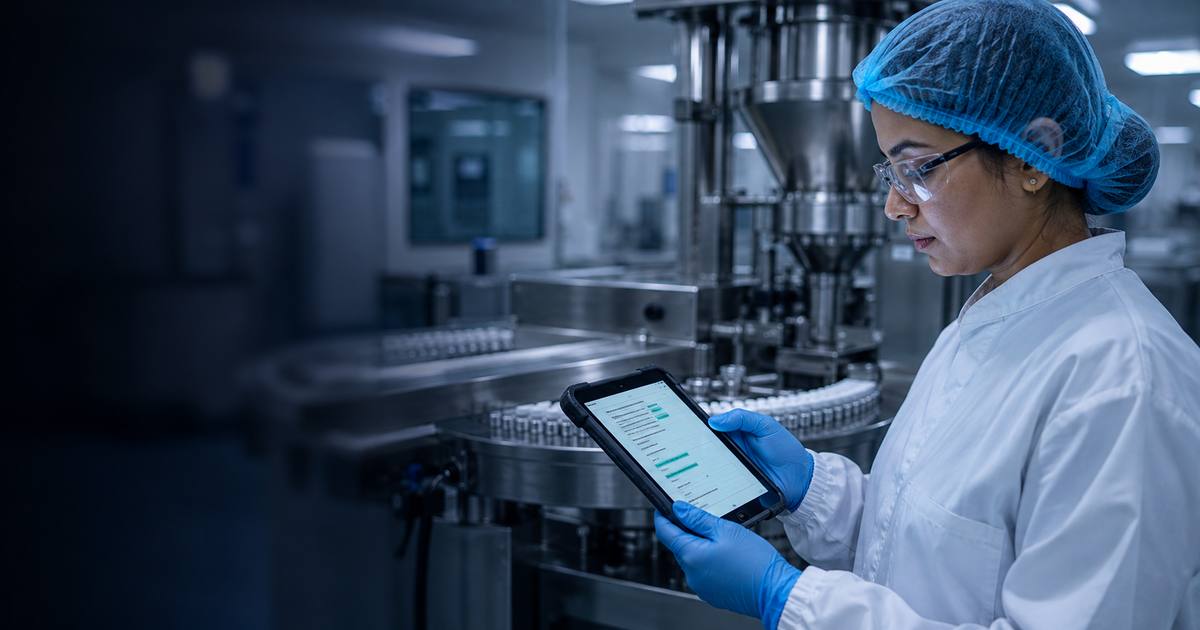
Artificial intelligence is software that learns from examples instead of being programmed with fixed rules. The U.S. Food and Drug Administration defines it as a machine-based system that, for human-defined objectives, makes predictions, recommendations, or decisions.
Translated: show the software enough examples and it applies the pattern to cases it has never seen. A spreadsheet formula does exactly what you wrote; AI was given examples and worked the rule out itself.
Thousands of labeled tablet images, months of sensor readings, years of documents.
What acceptable cases share; what defective ones share.
Measure how often it is right before anyone trusts it.
A new officer learns defects the same way: a senior shows accepted and rejected units until the difference clicks, because no rulebook covers every chipped tablet. AI learns like that, at far greater speed and scale, minus the judgment about what to do next; hold that distinction.
After ten years of reviewing batch records, I can spot a wrong entry the way a musician hears a wrong note. That is what artificial intelligence actually is: the same pattern recognition, industrialized. What it does not have is the judgment about what to do next. That part stays with us.
KPKinjal PatelSenior Consultant — QMS, Validation & GMP Compliance
Nearly every AI application in pharmaceutical manufacturing does one of three jobs. It sees: inspecting products or documents visually. It predicts: flagging unusual trends before they become failures. It drafts: producing a first version for a person to review. Place a tool in its lane and you understand most of what it does.
I call this the See–Predict–Draft Model, and it is the one diagram worth keeping. Each lane takes over the repetitive part of a task your plant already performs manually, and each ends the same way: a person checks the output. Large manufacturers run all three today; Novartis monitors plants with machine learning, Merck cuts false rejects with AI, and Moderna applies it in quality control (PharmExec, 2026).
Inspects every unit
A person decidesFlags drift early
A person decidesWrites a first version
A person decidesWhy the industry is paying attention
| The job | The manual task you already know | What the AI version does | What stays with people |
|---|---|---|---|
| Seeing | An inspector at a lightbox checking tablets or vials for chips, cracks, and color defects | Camera systems classify every unit at line speed and flag suspect ones | The disposition decision: what happens to what was flagged |
| Predicting | A senior operator eyeballing trend charts, sensing a machine “doesn’t sound right” | Models watch sensor and lab data continuously and flag drift early | The investigation: why it drifted, and what to change |
| Drafting | Writing a report or summary from a template and the last similar case | Software produces a first version in minutes from existing records | Review, correction, and the signature that makes it a record |
Across every AI system our team has shipped, in any industry, the work reduces to three jobs: look at something, forecast something, or write the first draft of something. The models change every year. The three jobs don’t.
MPMitesh PatelNVIDIA Certified AI Architect, Founder & Director, Brainy Neurals
Building the bigger picture? Continue with AI in pharma documentation for small and mid-size QA teams.
Read the pillar →AI “sees” by learning what acceptable and defective products look like from thousands of labeled images, then classifying every unit that passes a camera. It is the judgment an inspector exercises at a lightbox — chips, cracks, discoloration, print defects — applied through computer vision to 100% of units at line speed.
The manual version is genuinely hard: attention fades fast on repetitive visual work, and sampling can miss an intermittent problem entirely. The learned version holds one standard on every unit of every shift. Körber Pharma reports AI-powered inspection can cut false rejects (good units wrongly discarded) by up to 90% while raising detection by up to 40% (Körber Pharma).
What stays human is everything after the flag: what the defect means, whether the batch has a problem, what happens next. The camera raises its hand. A person makes the call.
Every AI application in a pharma plant does one of three jobs: it sees, it predicts, or it drafts. Every one ends with a person checking the output.
AI “predicts” by learning the normal behavior of a machine or process from historical data, such as vibration, temperature, pressure, and lab results, then flagging when readings drift from that normal. It is the industrialized version of the senior operator who feels a line running wrong before any alarm sounds.
The economics explain the attention. Unplanned downtime averages roughly $260,000 per hour across large manufacturing operations (Siemens, True Cost of Downtime, 2024), and a single pharmaceutical stoppage that invalidates a batch can exceed $9 million once destruction and recovery are counted (Augury, 2024, via SeQent); no survey publishes a reliable pharma per-hour figure, so the per-incident number is the honest one.
An early flag fixes nothing by itself. A person still decides whether to stop, inspect, or keep running; the prediction buys time for judgment, it does not replace it.
Foundations, one concept at a time. Every post in this hub explains one AI idea in plain words for pharma teams.
Browse the hub →AI “drafts” by learning from existing documents and producing a first version of a new one in minutes, for a person to review, correct, and sign. It is the newest of the three jobs, powered by large language models (the technology behind ChatGPT), and the one most likely to reach your desk next.
The early numbers come from document-heavy corners of the industry. McKinsey describes a generative AI tool at a life-sciences manufacturer that synthesized 70% of deviations and produced usable first drafts of corrective and preventive actions (CAPAs) in over 80% of cases, with closure time falling around 40% in case studies (McKinsey). A platform co-developed by Merck and McKinsey cut the first draft of a clinical study report from 180 hours to 80 (McKinsey, 2025).
Notice the word every example shares: draft. The software produces a starting point; a qualified person produces the document that counts. AI suggests; people decide.
The software produces the starting point. A qualified person produces the document that counts. That division of labor is the whole game.
No. Automation follows fixed rules an engineer wrote: a programmable logic controller (PLC) opens a valve at a set pressure, the same way every time. AI learned its behavior from data and deals in likelihoods, not certainties. Your plant has trusted automation for decades; AI is a newer, probabilistic layer arriving alongside it.
A useful test: if a system does exactly the same thing under the same conditions forever, it is automation. If its behavior came from examples, and it can be wrong in unfamiliar situations, it is AI. An Excel macro that formats a report is automation; software that reads a scanned page and interprets handwriting is AI. They fail differently, so they are supervised differently, and trust earned by one does not transfer to the other.
Four limits matter more than any capability: AI cannot work without historical examples, cannot guarantee it is right, cannot take responsibility, and cannot do the hands-on physical work that fills most of a plant day. Anyone selling past these limits is selling something else.
A product never made, a defect never photographed, a failure with no history: nothing to learn from, and the software will not announce that it is guessing.
AI errors do not look like errors; a wrong output reads as fluently as a right one, which is why serious deployments measure error rates before extending trust.
Software cannot own a decision. Every consequential output needs a named person who checked it.
Boston Consulting Group’s 2026 analysis found 57% of U.S. jobs resist heavy automation because they depend on physical presence, hands-on work, or sustained human interaction (BCG, 2026). That describes most of a plant.
I have trained new quality assurance officers for a decade. The pattern is always identical: they are accurate on checklist tasks within weeks, but the feel for a drifting trend, the sense that a batch record reads wrong, takes years. The surprise of AI is that it learns the checklist kind of task astonishingly fast. The fix for trusting it is rarely more enthusiasm or more fear. It is what works for every trainee: senior review, every time.
Kinjal PatelYou now hold the model the rest of your AI conversations will build on. When a colleague mentions an inspection camera, you know it is the seeing lane and the disposition still belongs to a person. When a vendor promises predictions, you ask what history the system learned from. When a tool offers to draft, you know the draft is where the work begins. The Foundations hub continues with how machines actually learn and what good data means in a plant; the wider picture lives in our AI in pharma pillar. The next time AI comes up in your morning meeting, you will not be the one translating. You will be the translator.
Send this to the person who nods along in AI meetings.
CopiedArtificial intelligence is software that learns from examples instead of following rules a programmer wrote. Show it thousands of labeled tablet images and it learns to spot defects; show it years of sensor data and it learns what normal looks like. It then applies those learned patterns to new cases, suggesting, flagging, or drafting, while a person decides what to do with the output.
In pharmaceutical manufacturing, AI works in three lanes: seeing (camera systems inspecting units and documents), predicting (models flagging unusual trends in equipment or lab data), and drafting (tools writing first versions of documents for human review). Each lane learns from historical plant data, and each ends with a person checking the output before anything is acted on or signed.
You do not need the mathematics, but a working mental model is becoming as basic as knowing what your quality management system does. Every role (operator, analyst, reviewer, plant head) will increasingly receive AI outputs as inputs to their own work. Knowing the three jobs AI does, and its four limits, is enough to use those outputs well and question them when needed.
No. Automation executes fixed rules an engineer wrote, so the same input always produces the same output, as with a programmable logic controller. AI learns its behavior from historical examples and produces likelihoods, which means it handles variation but can be wrong in unfamiliar situations. Your plant has decades of automation; AI is a newer, probabilistic layer arriving alongside it.
Machine learning is the main technique used to build artificial intelligence today: algorithms that improve at a task by learning from data. AI is the broader goal: software doing things that normally require human intelligence. In practice the terms overlap heavily, and almost every “AI” you will meet in a plant, from vision cameras to drafting tools, is machine learning under the hood.
The evidence points to reshaping rather than replacement. Boston Consulting Group’s 2026 analysis found 57% of U.S. jobs resist heavy automation because they depend on physical presence, hands-on work, or human interaction — a good description of plant roles. What changes is the mix: less transcription and repetitive checking, more reviewing, investigating, and deciding. The tasks move; the responsibility stays human.
Visual inspection of tablets, vials, and packaging is the most established use, followed by predictive maintenance on production equipment and drift detection in process and lab data. Document drafting is the newest arrival. Large manufacturers are public about it: Novartis monitors plants with machine learning, Merck uses AI to reduce false rejects in quality checks, and Moderna applies it in quality control.
Yes, and its mistakes are dangerous precisely because they do not look like mistakes. A wrong AI output is delivered as fluently and confidently as a right one, with no hesitation to warn you. That is why every serious deployment measures error rates before trust, keeps people reviewing outputs, and treats the software like a capable trainee: genuinely useful, always checkable, never the final word.

Kinjal Patel
Senior Consultant — QMS, Validation & GMP Compliance
Kinjal has spent 10 years in pharmaceutical quality assurance across QMS, validation, qualification, vendor management, quality risk management, documentation, and in-process quality control, on oral-solid and injectable manufacturing — including batch document preparation and issuance, batch record review, IPQA, product quality review, and training management.
Connect on LinkedIn →Early access
PharmaSynapse authors GMP batch documentation from your approved master records, and stops at the human signature line.
Keep reading
AI basics
AI is the umbrella, machine learning learns rules from historical data, generative AI creates new text on request. Which tool fits which job.
In preparationAI basics · People
Every quality decision still ends with a qualified person’s signature. Role by role, what stays and what shifts.
In preparation